The Pick 3 Is Random.
Your Thinking Doesn’t Have to Be.
A professional Excel workbook that helps you see how the Pick 3 is behaving — so you can stop guessing, stop chasing, and start narrowing your decisions with logic.
Tracks all 220 unique Pick 3 combinations
Filters by digits, pairs, sums, repeats, share behavior, and more
Shows what’s overdue, repeating, and flipping — at a glance
Works for any state with Midday & Evening draws
Built in Excel. One-time purchase.
Reusable year after year.

Why Most Pick 3 Systems Eventually
Let You Down
If you’ve played Pick 3 for any length of time, you’ve seen it:
Someone posts a “system.”
A list explodes to a mountain of combinations.
And somehow, the promise is still certainty.
The problem isn’t effort — it’s lack of structure.
Most Pick 3 systems fail because they:
• Generate too many numbers without a way to drill them down
• Ignore how combinations actually behave over time
• Chase the last hit instead of tracking patterns, flips, and repeats
• Treat every draw like a fresh universe, instead of part of a cycle
The result?
You’re left with long lists, rising costs, and no real way to decide what not to play.
And the truth is — Pick 3 is random.
But randomness still leaves footprints.
After recording draw results for years and watching the same arguments play out again and again, I realized something important:
The edge isn’t predicting the next number.
The edge is seeing how the game is currently behaving —
and narrowing your choices based on that behavior.
That’s exactly why I built the 317 Rundown & Combo Filter Workbook.
Everything Starts With the Draw History
Before any rundown, any filter, or any wager decision — there’s one thing that has to come first:
An honest draw history.
The biggest mistake Pick 3 players make is trying to “predict” without first observing.
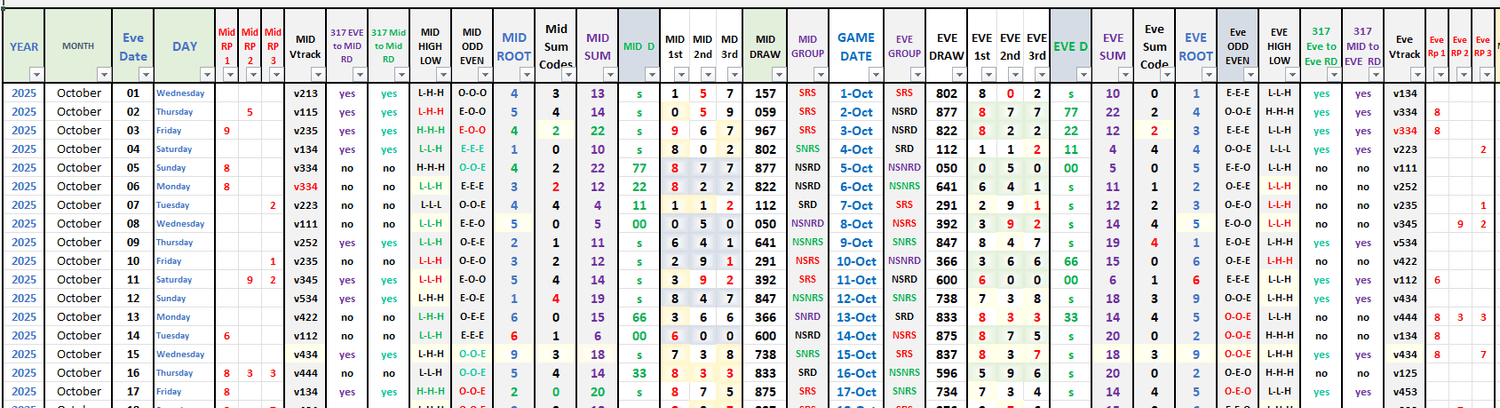
That’s why this workbook includes a dedicated Draw History worksheet — a clean, simple place to record each winning draw as it happens.
As you enter results, the worksheet automatically:
• Breaks each draw into its variables
• Tracks digits, pairs, roots, sums, highs/lows, odd/evens, vtracs
• Flags repeats and carry-overs
• Feeds live data into the Combo Filter, Dashboard and other counting worksheets in your workbook
This is where randomness starts leaving footprints.
When you collect your own draw history, something changes:
You stop chasing numbers
And start watching behavior
Once you have draw history in place, then the rundown becomes useful.
Not as a prediction engine —
but as a measuring tool.
Where the 317 Rundown Comes In
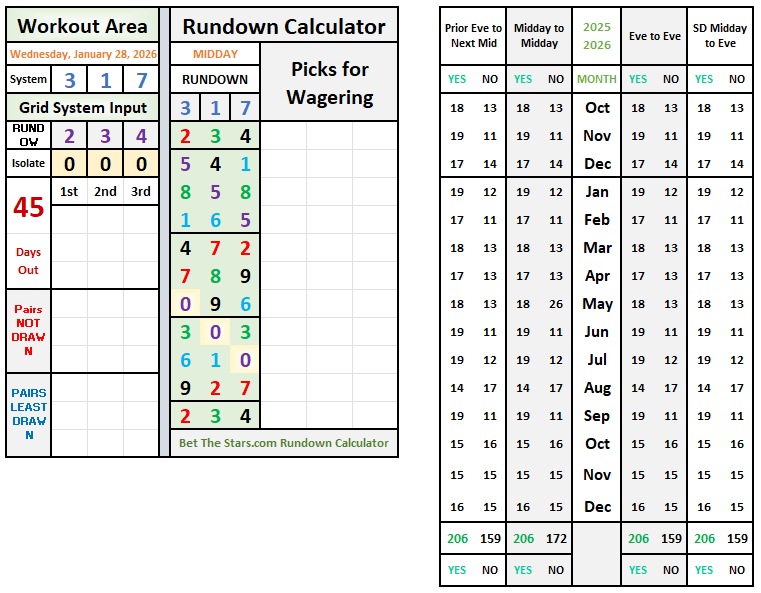
The Rundown Calculator is designed to work alongside your combo filter and your draw history — not replace it. But, it can be also be used all by itself, if you are in a hurry to get your picks in.
But moreover, and In addition,
The workbook is built so you can run any rundown you choose:
317, 618, 123, or your own.
As you use the rundown, again, the workbook allows you to record:
• When the next winning combination was in the grid
• When it was not
Over time, those results are counted and displayed — so you can see, in real numbers, how often your rundown is actually aligning with the game.
While I personally favor the 317 Rundown, and have experienced over the last three years of testing it, that the next draw combo is typically sitting around the Zero's, its allows me to make some good solid picks whether I'm using it with the combo filter or not.
I also learned during the three years of testing the 317 Rundown that most of the patterns the winning combos make in the grid are zigzag patterns, as opposed to just sitting in a row or column.
Why? because there are more zigzag patterns that can be made by the digits connecting to other digits.
And that holds up whether you might like to rundown midday game with midday game, eve to eve, or draw to draw.
Either way I've given you the ability to track all of them with a simple yes or no answer input into your draw history so that you can see that pattern emerge over time.
You’re not trusting the rundown.
You’re testing it. (see about changing this)
Once you have draw history in place, then the rundown becomes useful.
Not as a prediction engine —
but as a measuring tool. (we need to change this to something fitting)
Where the Combo Filter Comes In
Once you’ve recorded draw history you’re still left with the same question every Pick 3 player faces:
What do I actually play?
This is where most systems fall apart.
They generate lists…
but never help you reduce them intelligently.
The Combo Filter is the workspace where all of the information you’ve been collecting finally comes together.
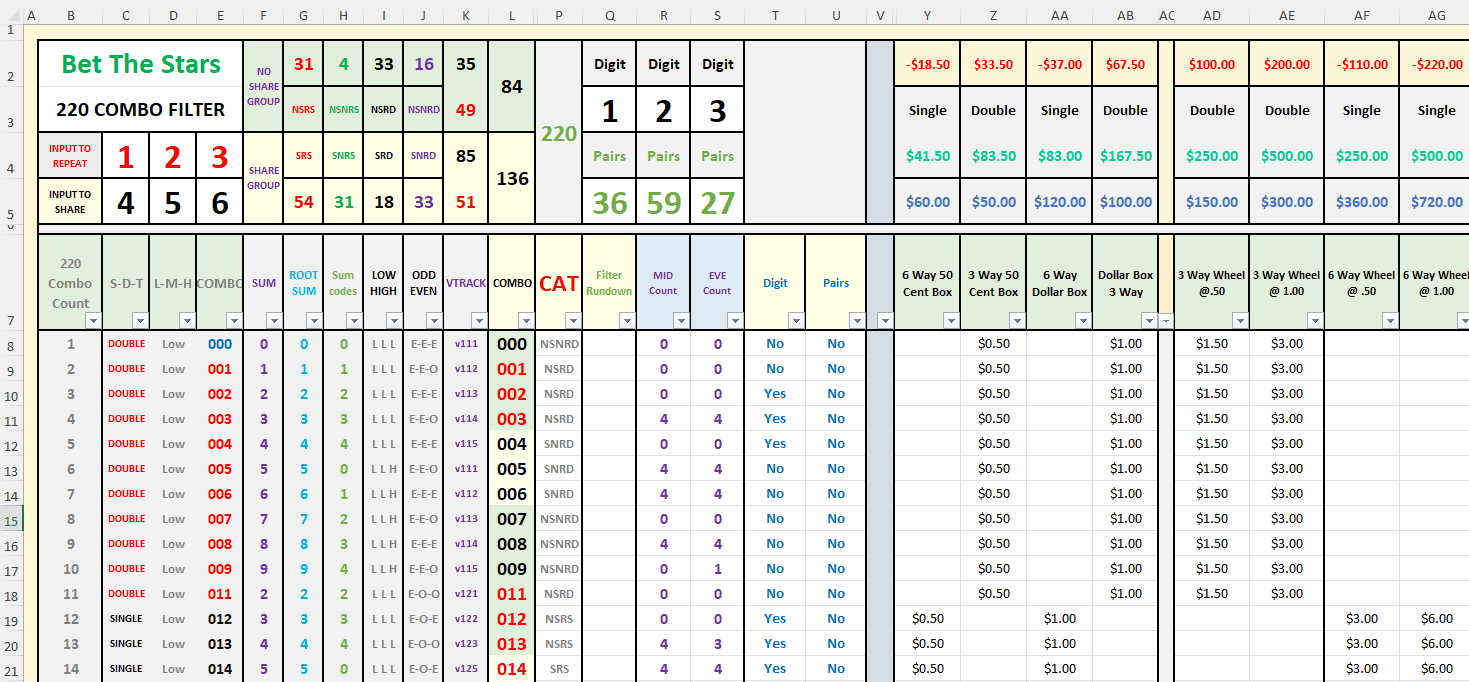
It starts with all 220 unique Pick 3 combinations — and then allows you to narrow that field using real, observable variables such as:
• Digits & pairs
• Repeats vs. non-repeats
• Carry-overs between Midday & Evening
• Sums, roots, high/low structure
• Odd/even behavior
• Rundown inclusion (in-grid vs. not in-grid)
Instead of guessing which numbers “feel right,” you filter down to combinations that match how the game is currently behaving.
Randomness doesn’t disappear —
but it organizes itself.
Why Cutting the Field Matters
Every Pick 3 wager has a cost.
Playing the full field isn’t strategy — it’s a budget problem.
As you filter combinations, the workbook automatically shows:
• How many combinations remain
• What it would cost to play them boxed
• What it would cost to play them straight
• Which wager types make sense for that group
You’re not just filtering numbers —
you’re managing exposure.
A list of 50 to 80 combinations might look impressive.
Until you see the price tag.
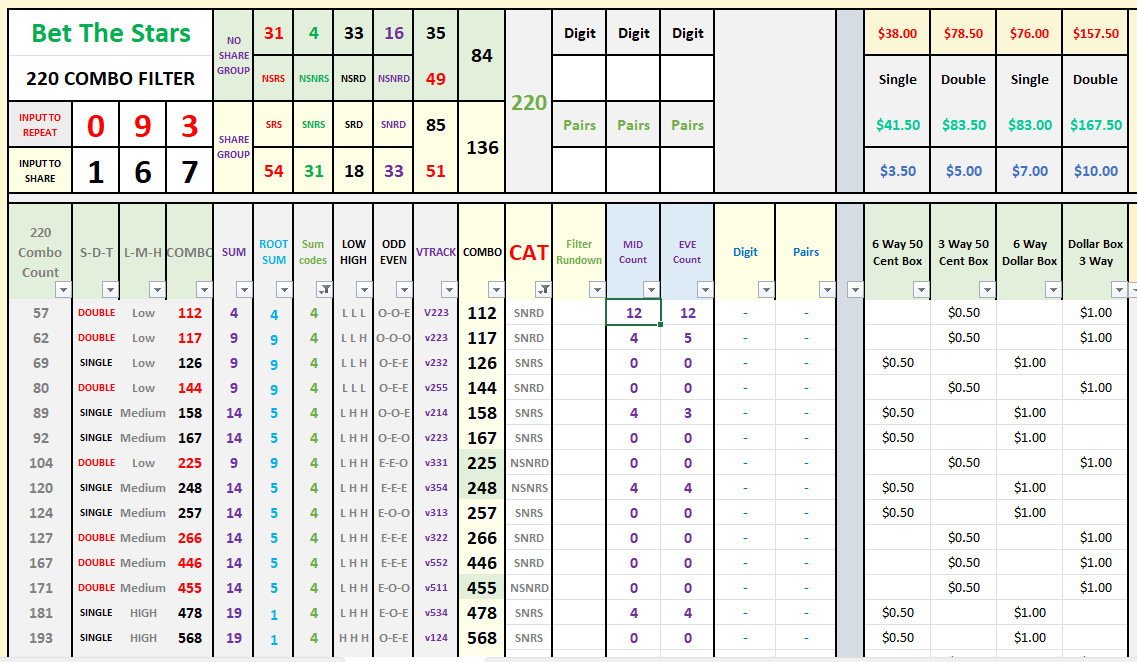
This is how the workbook helps you think like a player — not a chaser. And once you understand how the combinations are grouped, everything gets easier.
Why Only 220 Combinations Matter
Most Pick 3 players think they’re choosing from 1,000 possible numbers.
They aren’t.
When you strip away order — and focus on structure — only 220 unique combinations exist.
Everything else is just how you wager them.
The workbook is designed to separate:
Decision-making
from
Wagering mechanics
You decide which group you want to play from the 220.
Boxing and straight bets come after that decision.
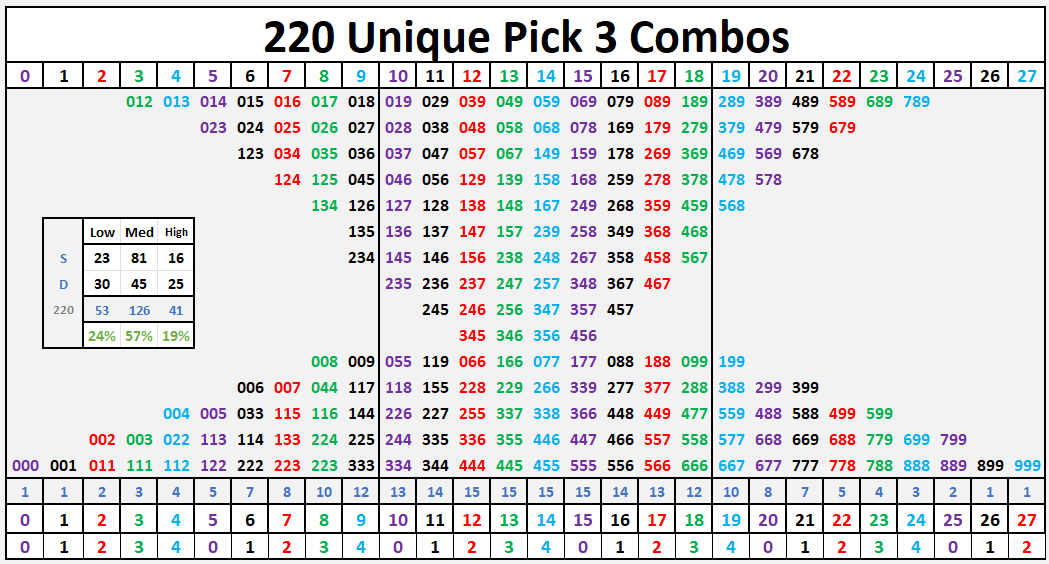
Inside the workbook, you’ll find worksheets that clearly show:
• How the 220 combinations divide into Low / Medium / High sums
• How many are Singles vs. Doubles
• How they break down by sum codes, roots, odd/even, high/low
This matters because not all groups are equal in size.
THE KEY TRUTH
Medium sums hit more often —
not because they’re “hot,”
but because there are simply more of them.
That’s structure, not luck.
TURN STRUCTURE INTO STRATEGY
Once you understand that structure, timing becomes everything.
For example:
• After a 3–5 day run of Medium sums,
• It often makes sense to filter Medium out entirely,
• And focus only on Low and High groups.
From there, you can narrow further using what you like to look at:
• V-Tracks
• Digits
• Pairs
• Sum roots
• Shares or No Share
repeats or No Repeats
Rundown Counts
The workbook counts all of this automatically as you enter draw history and I fashioned the combo filter worksheet so that you can sort those 220 unique combos anyway you see fit, by seeing the patterns trending from your Draw History worksheet.
WHAT THESE EXTRA SHEETS ARE REALLY FOR
The additional worksheets aren’t there to overwhelm you.
They exist so you can:
• See how each group behaves over time
• Understand why certain filters make sense right now
• Stop chasing numbers and start watching patterns shift
You don’t need to use every variable —
but it’s powerful to see them counted and tracked.
Once you understand the 220, everything else clicks.
Now the question becomes:
How do you actually use this day-to-day without overthinking it?
A Simple Daily Workflow (Without Playing Every Day)
Let’s be honest about the Pick 3 game for a moment.
The wager structure and prize payouts are not designed in your favor.
If they were, state lotteries wouldn’t exist.
That doesn’t mean you can’t enjoy the game —
it just means you need to play it with awareness.
This workbook is not about forcing daily bets.
It’s about watching the game every day —
and choosing when to step in.
DAILY WORKFLOW
Step 1: Record the Draw
Each day, you record the Midday and Evening results in the Draw History sheet. Sometimes, I step away from recording for a few days to let the game unfold itself and just play catch up entering the draw results from where I left off.
Everything else updates automatically — counts, variables, trends.
Step 2: Observe, Don’t Chase
Most days, you don’t need to wager at all.
Instead, you’re watching for:
• Runs
• Flips
• Breaks in pattern
• Overstayed groups
• Underrepresented groups
This is where patience pays.
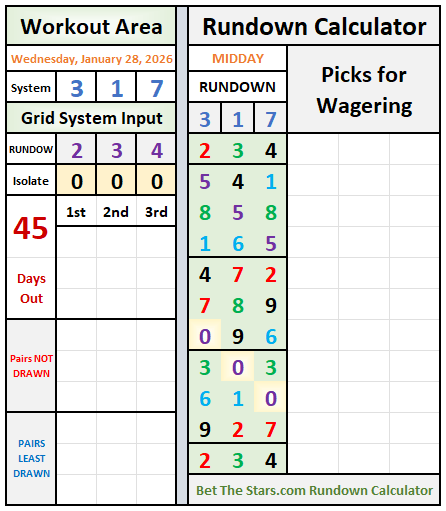
Step 3: Use the Rundown as a Measuring Tool
When you decide to test a rundown (317, 618, or one you prefer),
the calculator helps you track:
• When the next draw does appear in the grid
• When it does not
Over time, this builds confidence —
not expectation.
For instance, 5 days in a row of seeing the next drawn combo in the grid tells you if about to flip to not being there. So you can actually bet against the grid using your combo filter because it will tell you which of the 220 unique combos are not in grid when you input your last draw.
Plus, You can use the area provided to the left of rundown to input the digits and pairs that are over due that you can get from your Dashboard to help you sight combos that happen to be sitting around the Zero's.
Or,
You can actually even skip this step and just use your Combo Filter, if you want to chase an over Sum or see that run of repeating digits is about to flip. That is the beauty of this workbook design.
Step 4: Filter the 220 — Not the 1,000
When conditions line up, you move to the Combo Filter.
Instead of thinking:
“What number should I play?”
You ask:
“Which group makes sense right now?”
You filter by:
• Sum behavior
• Singles vs. doubles
• Pairs
• Digit activity
• Rundown inclusion
Shares or No Shares
The workbook shows you how many combinations remain
and what they would cost to wager.
Step 5: Choose When to Play
Some days, you play.
Some days, you don’t.
That’s not losing discipline —
that’s protecting your bankroll.
And when the game doesn’t go your way?
You don’t spiral —
because you understand the structure and know another flip on one of the variables belonging to each of the 220 unique combos is coming.
Step 5: Choose When to Play
This is still the Pick 3 game.
Anything can happen.
The difference is:
• You’re no longer guessing blindly
• You’re no longer chasing losses
• You’re no longer disappointed by randomness
You’re watching the game unfold,
and stepping in when conditions make sense.
If you love numbers, patterns, and watching systems move —
this workbook gives you a way to enjoy the game
without letting it enjoy your wallet.
What This Workbook Is — and Isn’t
There’s no shortage of Pick 3 systems promising certainty.
This workbook is not one of them.
It’s built for people who enjoy numbers, patterns, and structure —
and who understand that the Pick 3 game will always include randomness.
WHAT THIS WORKBOOK IS
This workbook is:
• A structured way to record and study draw history
• A framework for understanding how the 220 unique combinations behave
• A tool for observing runs, flips, and pattern shifts
• A way to reduce the field intelligently before wagering
• A method for tracking when a rundown does and doesn’t align
• A guide for managing exposure and cost, not chasing hits
• A companion for people who enjoy watching the game unfold
It’s designed to help you think clearly, not emotionally.
WHAT THIS WORKBOOK ISN’T
This workbook is not:
• A guaranteed winning system
• A “play every day” betting strategy
• A shortcut to beating the lottery
• A replacement for bankroll discipline
• A promise that today’s patterns repeat tomorrow
• A reason to ignore the cost of wagering
If you’re looking for certainty, this isn’t it.
If you’re looking for clarity, you’re in the right place.
THE KEY DIFFERENCE
The Pick 3 is random.
Your thinking doesn’t have to be.
WHY THIS MATTERS
Most disappointment in gambling doesn’t come from losing —
it comes from expectations that were never realistic.
This workbook helps remove that frustration by showing you:
• When conditions align
• When they don’t
• And when it’s best to simply watch and wait
Knowing why you didn’t play is just as important as knowing why you did.
Some days, the workbook will tell you:
“Not today.”
And that’s a win.
So what exactly do you get when you purchase the workbook?
Let’s break it down.
What You Get for $37
This is a one-time purchase.
No subscriptions.
No upgrades.
No recurring fees.
You buy it once — and reuse it year after year.
1. The 317 Rundown Calculator (Fully Adjustable)
• Built for the classic 317 Rundown, but not locked into it
• Use any rundown you prefer (317, 618, 123, or your own)
• Input overdue digits and watch the grid update instantly
• Track how often the next draw appears inside the grid
• Includes a built-in count block so you can measure performance over time
This isn’t about prediction —
it’s about measurement and awareness.
2. The 220 Combo Filter (Your Decision Engine)
• All 220 unique Pick 3 combinations, fully structured
• Filter by:
Singles vs. doubles
Sums, roots, sum codes
High / Low / Medium groups
Digits and pairs
Rundown inclusion (in-grid vs. not-in-grid)
• Automatically shows:How many combinations remain
Estimated wagering cost for boxed and straight plays
but moreover, you can
Input the last two draws and breakdown the 220 into their respective groups showing you what combos would repeat a digit, and which will not from the same game prior, and how many would or would not share in a digit carrying over from the Eve game the night before. I have ohio data from 2011 that showing a Share Repeat single, and the No share Repeat Single are two groups in the Share and No Share category that will turn out more often than any other group. So when you get a run of days when the Midday game has share a digit with the eve game prior its gonna flip to a No Share, your combo filter will return you those combos which will allow you to further drill down from there.
This is where you stop guessing
and start reducing the field intelligently.
3. Draw History Worksheet (The Truth Layer and at a glance awareness)
• Record Midday and Evening results
• Variables populate automatically
• Counts update as history grows
• Tracks and is color coded so that your can see at a glance:
Repeats
Carry-overs between games
Group behavior through time
This is the foundation —
without it, nothing else matters.
You just make a decision about where you think the next draw is ripe to land.
4. Dashboard (At-a-Glance Awareness)
• View recent behavior over customizable day ranges
• Monitor:
Digit and pair activity
Sum behavior
Odd/Even and High/Low shifts
Share vs. no-share trends
This page answers one question quickly:
“What has the game been doing lately?”
5. Reference Worksheets (Structure Made Visible)
• Visual breakdowns of how the 220 combinations are grouped
• See why Medium sums hit more often (because there are more of them)
• Understand how Singles, Doubles, and Sum Groups stack up
• Helps you recognize when waiting for a flip makes sense
These sheets aren’t required every day —
but they teach you how the game is built.
WHY $37 MAKES SENSE
A standard Pick 3 boxed hit pays $50.
This workbook costs less than one boxed win —
and gives you:
• Structure
• Clarity
• Awareness
• And a way to enjoy the game without chasing it
It won’t promise wins.
It will help you make better decisions.
FINAL REASSURANCE
The Pick 3 will always be random.
This workbook helps you stay steady inside that randomness.
If you love numbers, patterns, and watching a game unfold —
this was built for you.
Download the 317 Rundown & Combo Filter Workbook
One purchase.
Unlimited use.
Your thinking — sharpened.
Everything you need to know about How to Play the Pick 3 draw games and use the 317 Rundown.


Subscribe now to get daily updates.